THE SUSSEX MOTIVE POWER DEPOTS WEBSITE.
HAS NOW BEEN MOVED TO A NEW SITE CALLED
IGNITING THE FLAMING OF UNITY
https://ignitingtheflameofunity.yolasite.com/
PLEASE CLICK ON THE IMAGE BELOW
TO TRANSFER TO THIS NEW SITE
CLICK ON THE ABOVE IMAGE TO TAKE YOU
TO THE NEW UPDATED COMBINED AND WEBSITE
IGNITING THE FLAME OF UNITY WEBSITE
https://ignitingtheflameofunity.yolasite.com/
THIS WEBSITE COMBINES THE FOLLOWING WEBSITES
THE BRIGHTON A.S.L.E.&F., THE BRIGHTON MOTIVE POWER DEPOTS
& THE SUSSEX MOTIVE POWER WEBSITES
WHICH EXPLAINS THE EVOLUTION OF THE FOOTPLATE GRADES AND THE
HISTORY OF THEIR TRADE UNIONS AND THE STRUGGLES TO IMPROVE
THEIR WORKING LIVES
CLICK ON THE ABOVE IMAGE TO TAKE YOU
TO THE NEW UPDATED COMBINED AND WEBSITE
IGNITING THE FLAME OF UNITY WEBSITE
https://ignitingtheflameofunity.yolasite.com/
THIS WEBSITE COMBINES THE FOLLOWING WEBSITES
THE BRIGHTON A.S.L.E.&F., THE BRIGHTON MOTIVE POWER DEPOTS
& THE SUSSEX MOTIVE POWER WEBSITES
WHICH EXPLAINS THE EVOLUTION OF THE FOOTPLATE GRADES AND THE
HISTORY OF THEIR TRADE UNIONS AND THE STRUGGLES TO IMPROVE
THEIR WORKING LIVES
I am trying to find out the names of the A.S.L.E.F. Branch Secretaries for the Littlehampton Branch and the dates they served between. if you have any info please can you let me know.
S.H. BROWN C1950s F. Janaway c1980, R. Dorkings c1990 - 1995
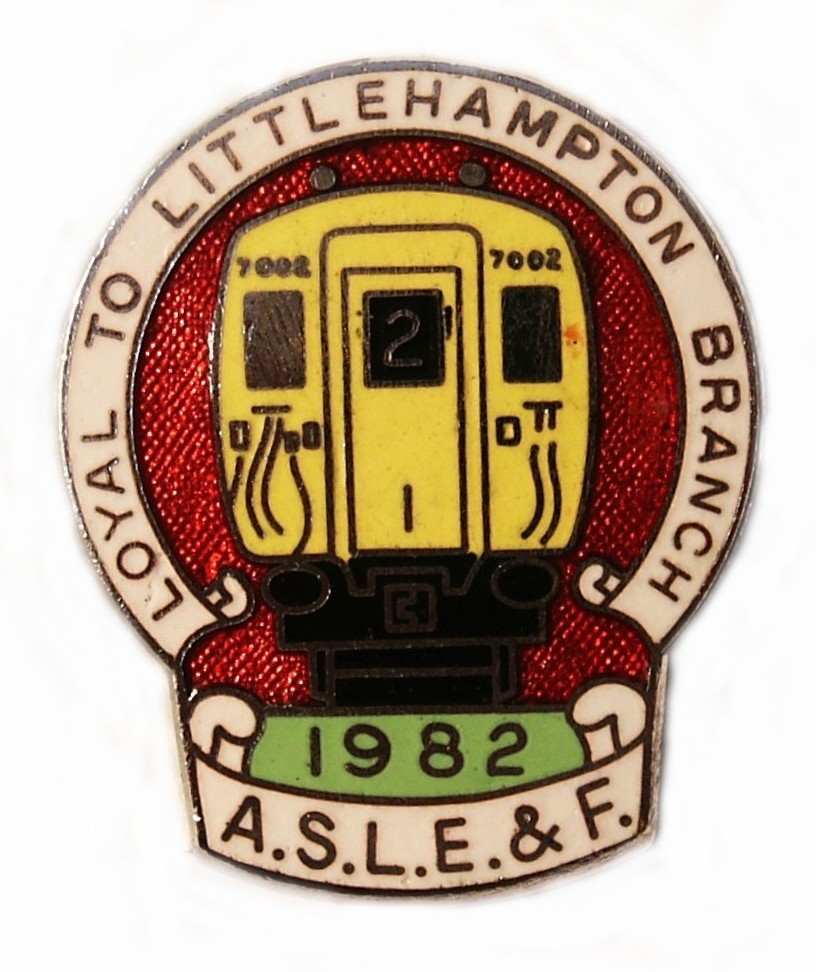
LITTLEHAMPTON
LOCO
This web page is dedicated to all A.S.L.E.&F. members who have worked at
Littlehampton depot over the years, and it features A.S.L.E.&F. members who brought
the trains of Littlehampton to life.
Chichester locomotive shed two road shed on the Down Side.
Close: Date unknown, but early 1870s during Stroudley's `House Cleaning'. The shed disappeared in the works
The Littlehampton Locomotive Shed (Shed Code Lton) was opened on the 17th August 1863 by the L.B.S.C.R. and
was opened to replace the nearby Lyminster shed which was opened on the 16th March 1845 by L.B.S.C.R. The
Lyminster shed was closed on the same day as the Littlehampton shed was opened.
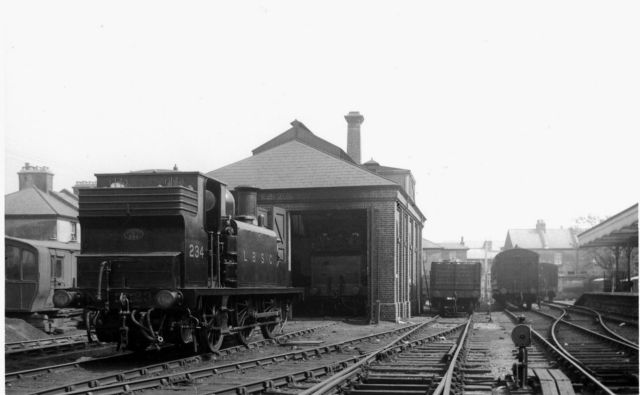
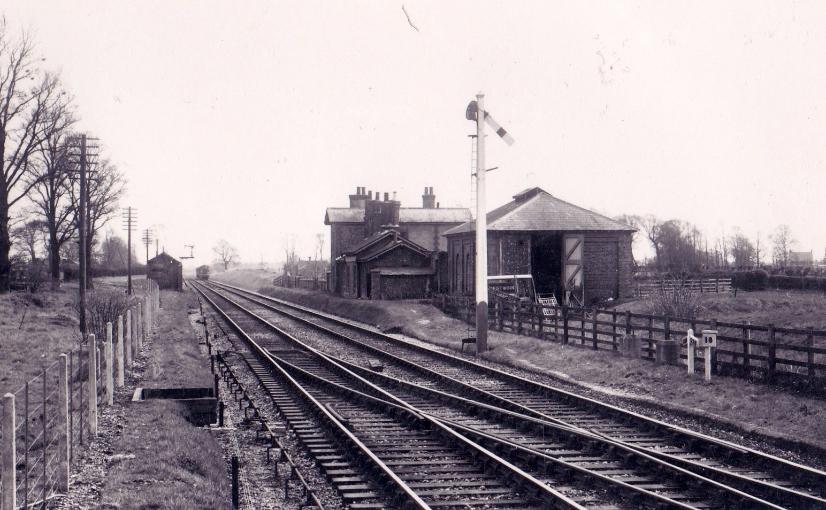
Littlehampton shed can been on the left hand side of the photo below. Littlehampton steam depot was a sub-depot of
Bognor Regis. Littlehampton Loco Shed was closed in 1937 to make way for the re-modelling of the station area as
part of electrification of the Sussex West coast lines. The locomotives allocated for Littlehampton where re-allocated
to the parent depot at Bognor with some locomotives being transferred in to Brighton depot. The Loco Shed still
survives today.
With the electrification arriving in Littlehampton on 6th February 1938, this created a new motorman’s depot at
Littlehampton (E.M.U.T. ) which opened in c1937.
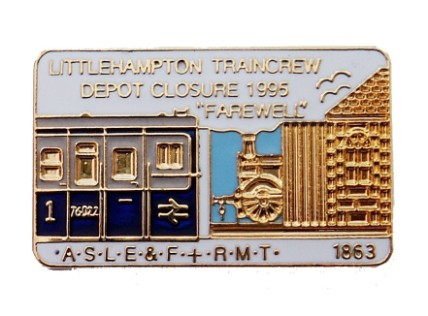
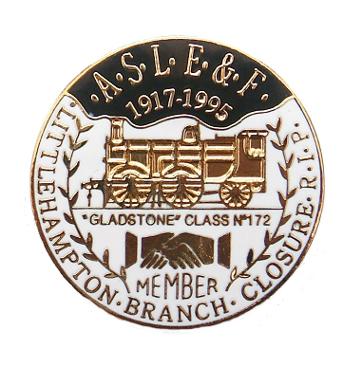
In 1995 The Littlehampton Depot was closed and the drivers transferred to the newly opened Barnham depot
Littlehampton A.S.L.E.&F. members had been part of the Horsham Branch until the open of their own Branch of
A.S.L.E.&F. was opened in c1913 and closed in 1995.
PHOTOGRAPHER UNKNOWN
Lyminster Station with Loco Shed (16th March 1845 - 17th August 1863 ) behind the station buildings
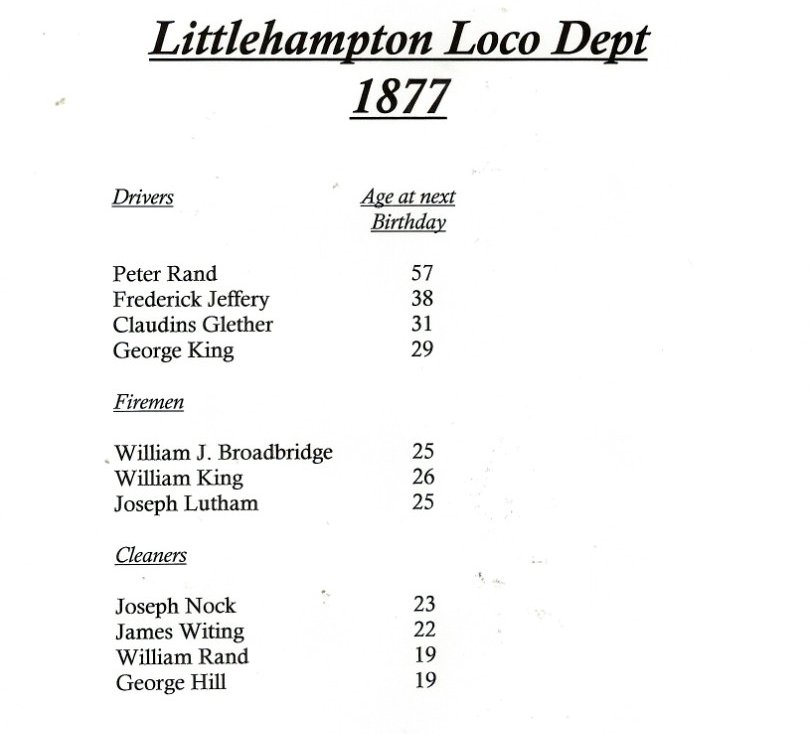
Above is a list of all the engine men that where employed at Littlehampton Locomotive Department in 1877. It is not know if this is list was compiled in seniority order or not. However, the list does clearly indicates the difference in the ages of both drivers & fireman at that period of time.
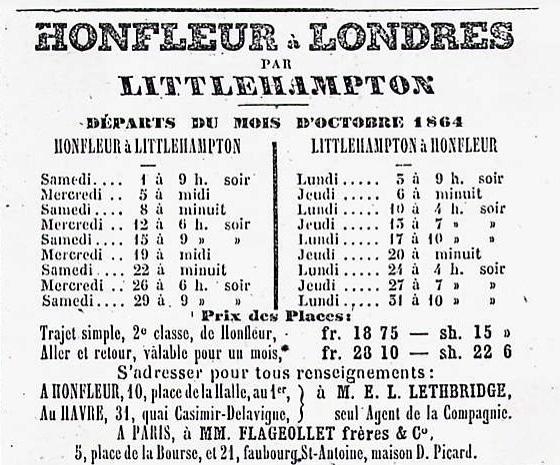
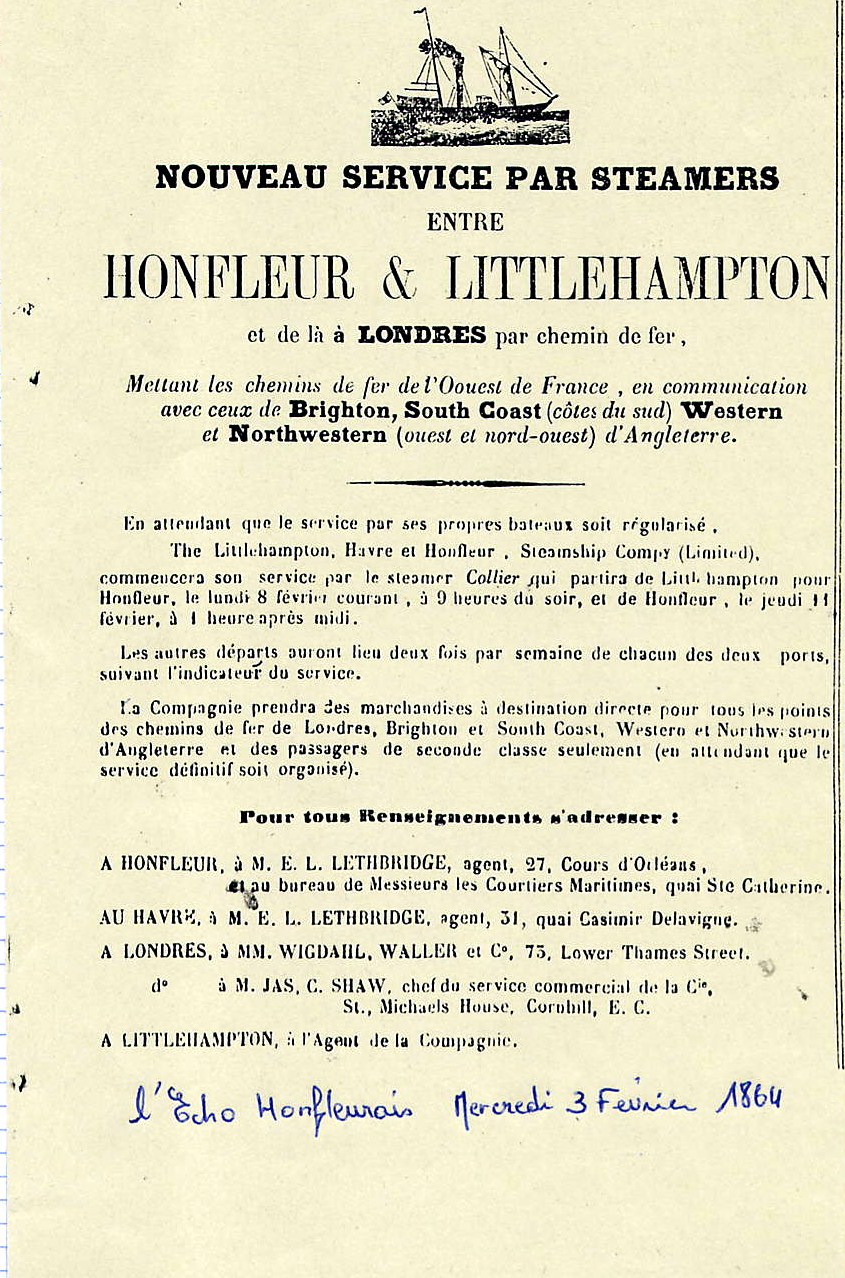
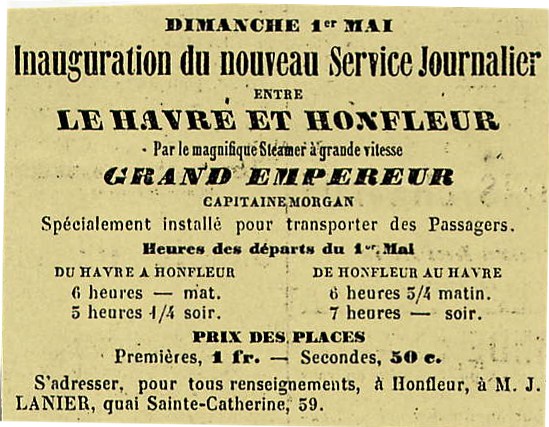
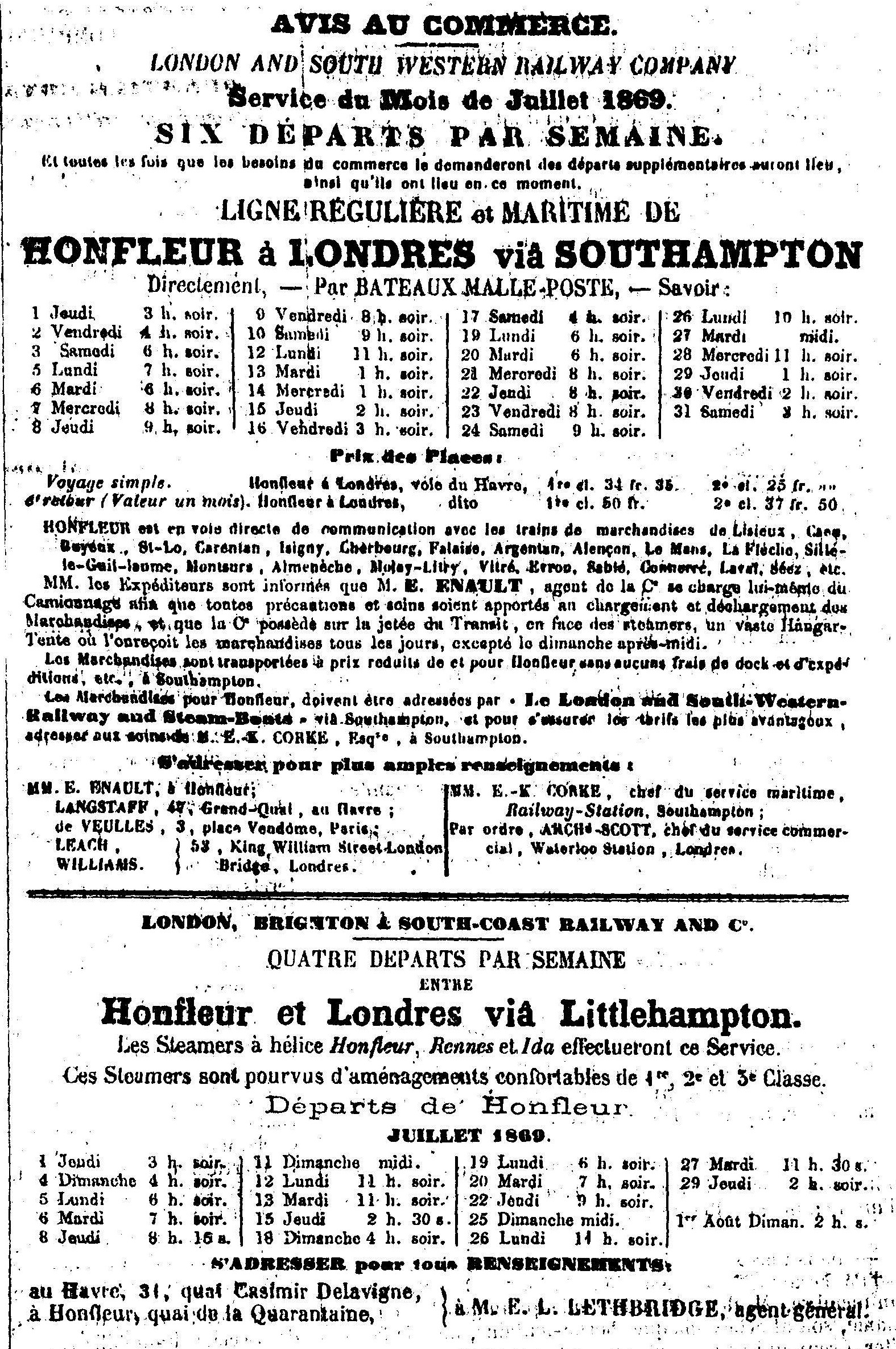
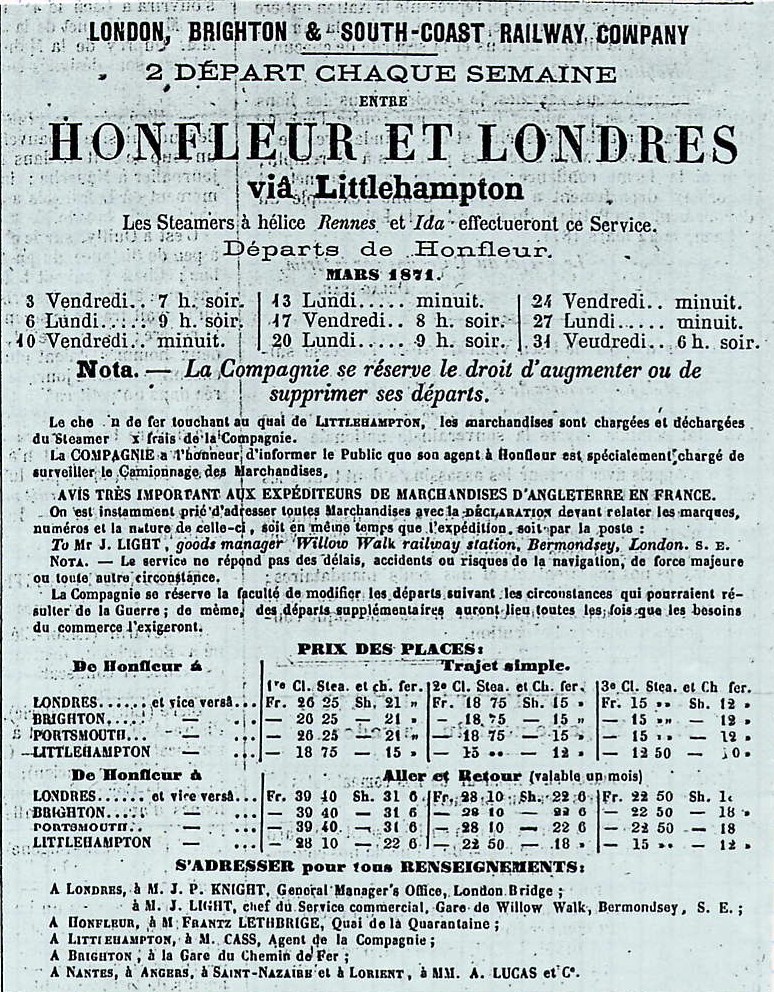
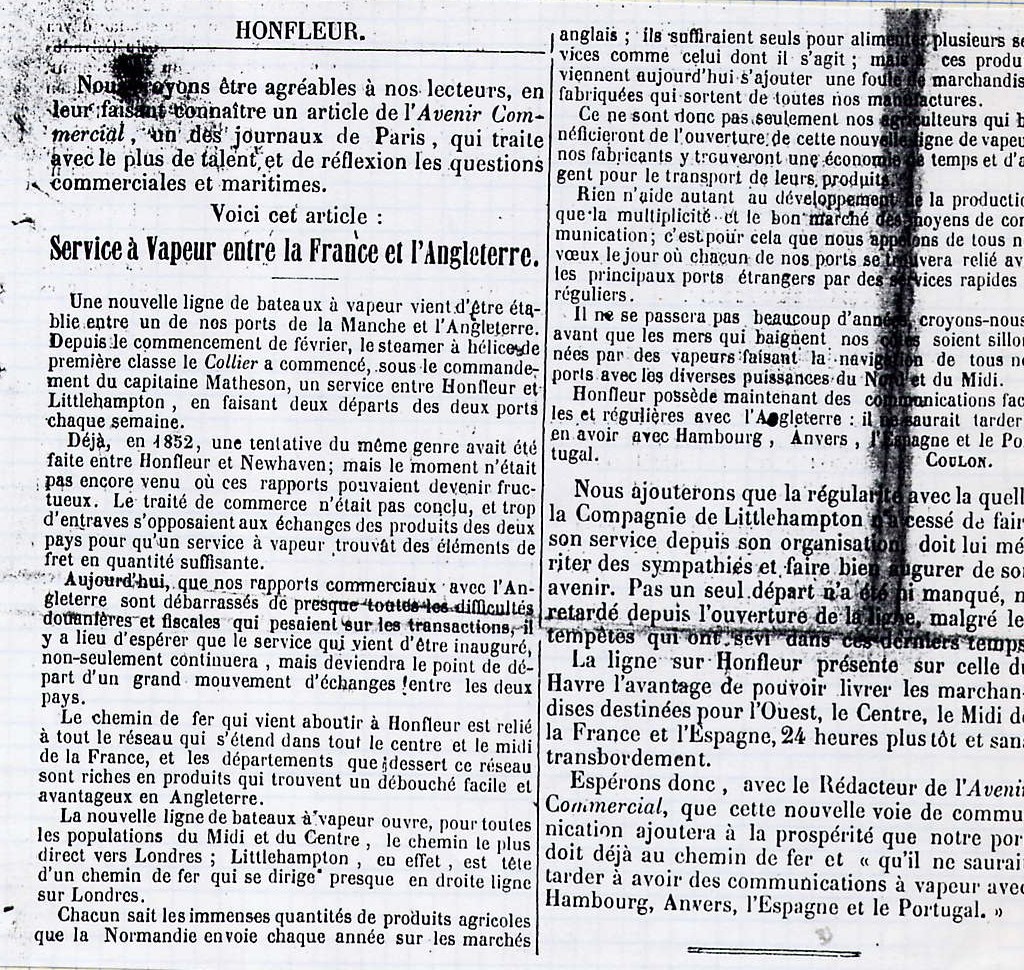
French adverts, advertising the ferry to Littlehampton 1864 - 1871
PHOTOGRAPHER UNKNOWN
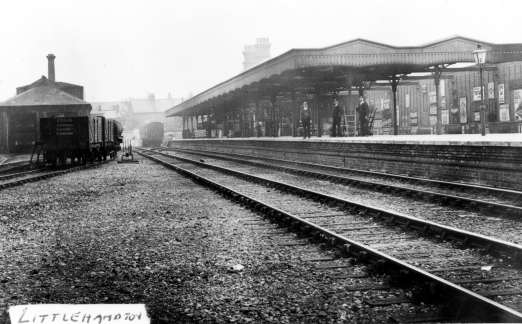
FORD STATION
30th JANUARY 1861
EXTRACTED FROM THE REPORT BY
H.W. TYLER, CAPTAIN R.E.
The accident, occurred on the 30th January last, near the Ford Station of the London, Brighton, and South Coast
Railway.
To the east of that station there is a sliding bridge over the river Arun, carrying only one line of rails; and the points
which connect the double lines with the single line of rails at the two ends of that bridge are under the charge of two
points-men, one to each pair of points.
A double semaphore signal on the east of the bridge is considered as the governing signal, employed for the
protection of the bridge and the single line passing over it. There are distant signals, working in each direction; and
the station signal is not permitted to be lowered for the passage of a train from the westward, excepting when the
signal on the east of the bridge is lowered also. A small wire signal communicates from the station to the west of the
bridge.
On the 30th January, the 6 a.m. passenger train from Portsmouth, consisting of an engine and tender, 5 carriages, and
2 break-vans, approached the Ford Station about four minutes late; and the driver found the signals lowered for him
to pass the station and bridge in the usual manner. He proceeded over the bridge at 14 or 15 miles an hour, which is
the greatest speed permitted at this point by the Company's regulations; and he saw the engine of another train
waiting upon the down line of rails, for his train to travel first over the single line. As soon as he had passed the points
on the east of the bridge, he became aware that the points-man had turned him on to the down line, instead of
allowing him to proceed along his own line, and that a collision was inevitable. He had just time to reverse his engine,
but no time to whistle for his breaks, before he struck the engine of the cattle train. He remained on his engine, and
was not much hurt. The fireman, after giving his break-handle one or two turns, also tried to jump off; but he only
succeeded in getting on the lower step of the engine before the collision occurred; and he was stunned, by being
thrown upon the ballast between the two lines, and cut about the face.
The guard who was riding in the leading van, Alfred Moore, remembers having passed the Ford Station, but nothing
more. He was found senseless in his break-van after the collision, and was evidently much hurt. There were
fortunately only 3 passengers altogether, 2 soldiers and a pensioner, in the passenger train; and they do not appear to
have suffered much from the shock. There were some butchers also in the cattle train, who were some of them hurt; so
that about 6 persons, besides the above fireman and guard, may be said to have been injured, more or less, from the
effects of the collision.
The pointsman, who occasioned this accident, is an old servant of the company, with an excellent character, and he
had been at the same post for 12 months. He saw the cattle train approaching from Brighton, about 5 minutes late;
and he says that the driver passed the distant signal with his steam on, and he was a little afraid that he would not
stop short of the points leading to the single line. He also saw the passenger train approaching from the opposite
direction, and he lowered his signals, according to his usual practice, for this latter train, while he kept his signals at
danger against the cattle train. He admits his mistake in turning on the points for the up line, and in thus causing the
passenger train to run the wrong way through them; and he says that he did so unwittingly, while looking round,
with.some anxiety. to see whether the cattle train had come to a stand sufficiently far from them to allow the passenger
train to pass in safety. He did not perceive his error until after the engine had passed throul!h the points; nnd he then
considered, wisely, that it was better to keep them in the wrong position, rather than to alter them, and throw the
passenger train off the line.
The driver of the cattle train denies having run past the distant signal with his steam on, and he is corroborated in his
evidence in this respect, by his fireman and his two guards. He states that he brought his train to a stand about 100
yards short of the points, and had been so standing for about 3 minutes before the collision occurred. He and his
fireman had time to jump off and get out of the way, after they saw that the passenger train bad been turned the wrong
way through the points. His tender wheels, and two or three of his cattle trucks were thrown off the line, in
consequence of the road having been burst out on one side.
The first breaks-man of the cattle train also had time to jump out of his van, after perceiving that the passenger train
had taken the wrong line; but the guard at the tail of the cattle train had not time to do so, and be received a contusion
on the forehead.
It is admitted by the points man that this accident was caused by his mistake; and, as it appears that he only altered
the points when the passenger train was within about 30 yards of him, it is plain that any indicating signal which
might have been attached to them would not, in this instance, have been of much use. At the same time, it is desirable
in cases of this sort, in which points have to be constantly altered for the passage of trains in different directions,
either that they should be worked in connection with a min signal near them, according to the system which has of
late been carried out so judiciously at the junctions upon this Railway, or else that they should be attached to a small
indicating signal, so places as to inform an approaching driver of the direction in which they are set, and whether it is
safe for him to proceed through them.
The best remedy, in this particular case, would be the construction of a new bridge, and the doubling of this portion of
the line; a measure which the company are anxious, I believe, to carry out as soon as possible; and it would be a
prudent course in the meantime to make some such alteration (by working the points in connexion with a signal) as
that which I have above referred to.
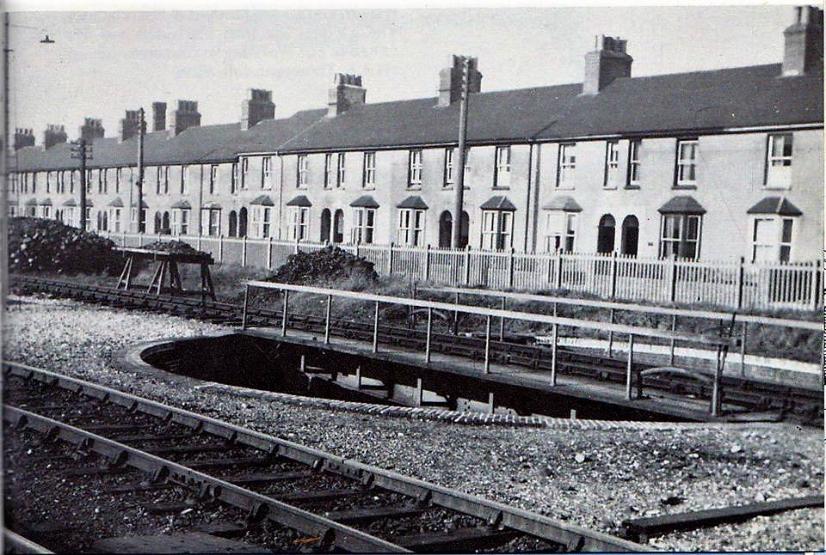
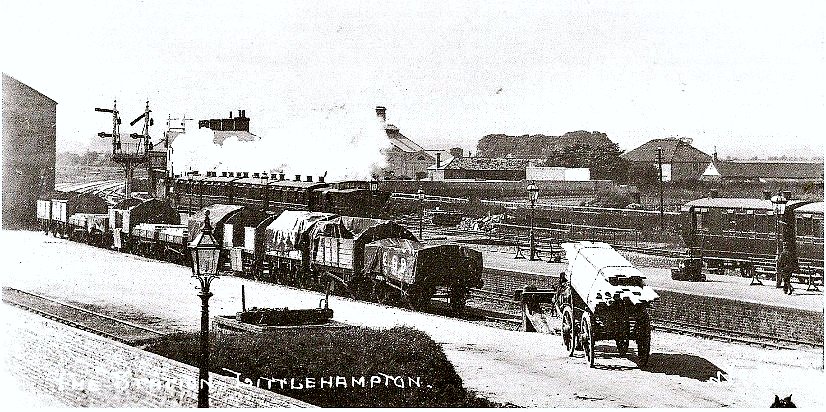
PHOTOGRAPHER UNKNOWN
FORD STATION
4th MAY 1867
EXTRACTED FROM THE REPORT BY
C.S. HUTCHINSON, CAPTAIN R.E.
A passenger train from Littlehampton to Ford ran into a train of empty carriages standing in a siding at the Ford
Station of the London, Brighton, and South Coast Railway, on which occasion six passengers and the guard of the
train were injured; no bones were broken, but the injuries consisted of cuts and severe shakes.
Ford is a junction station on the line from Brighton to Portsmouth, the Mid-Sussex line entering it from the north, and
the Littlehampton line from the south.
There is a signal box at the junction of the three lines; to
the westward of this a wooden bridge over the Arun, and
then a station signal-box close to the east end of the
platform. The down or south plat form is double-faced,
and the siding on its southern face is continued to the
westward till it rejoins the main line 400 or 500 yards from
the platform. The trains from Littlehampton to Ford
usually draw up to the platform on this siding, and it is
customary to use the western portion of the siding for empty engine and tender attached to s train of empty carriages was standing on this siding, the engine being at the east end of the train, and about 250 yards from the station signal-box, or l20 yards from the west end of the platform, which is 130 yards long.
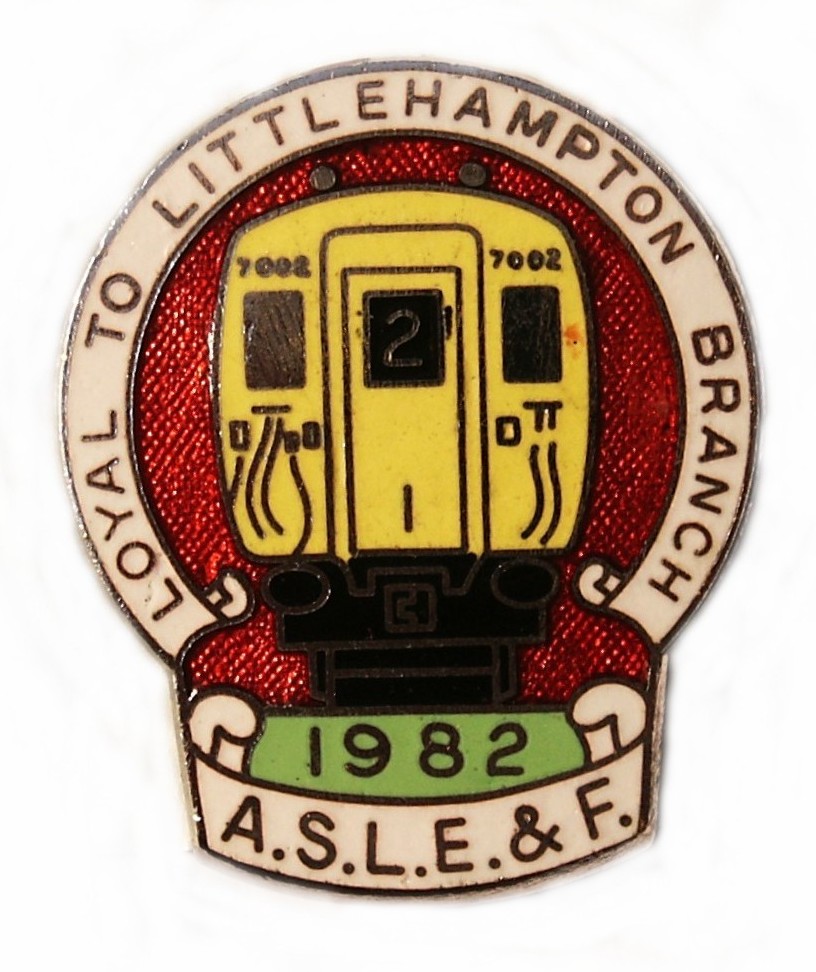
Click on icon for the full report
empty engine and tender attached to s train of empty carriages was standing on this siding, the engine being at the
east end of the train, and about 250 yards from the station signal-box, or l20 yards from the west end of the platform,
which is 130 yards long.
The passenger train from Littlehampton to Ford consisted of a six-wheeled engine (with 5 ft. 6 in. driving wheels) and
tender, a third-clam carriage, second-class carriage, first-class carriage, and break van, Provided with ordinary
break power, coupled in the order stated. The guard states that the train left Littlehampton at 6.40 p.m. on the 4th
May, and that they proceeded at a rather faster rate than usual up to the bridge over the Arun, the signals being all
right for them to enter the station; but that the speed from this point, instead of being gradually reduced as is usual,
did not slacken till the station box was reached, when, afar running for about 20 yards at a reduced rate, the train
again shot ahead, and maintained its increased rate of speed until it ran into the engine of the empty train on the
siding. Before reaching: the bridge the guard states that he applied his break, and kept it hard on until the collision
occurred; and this statement is corroborated by other testimony. He was unable to communicate with the driver, from
the absence of any means of doing so. The driver of the engine of the train of empty carriages stated that be happened
to be standing at the each end of the platform when the Littlehampton train passed. From the rate at which the train
was going (which he estimated at from 18 to 20 miles an hour) he felt sure a collision would occur, and flowed the
train as quickly as possible. On reaching the engines he found his own had been knocked back about 40 feet ; and he
observed that the break blocks of the tender of the engine from Littlehampton were off as far as the screw would
admit, giving him the impression that the handle had been turned the wrong way. This driver's fireman was standing
on the main line opposite to his engine when the collision occurred; he also estimated the speed of the Littlehampton
train at from 18 to 20 miles an hour, and observed that the break blocks of the tender were right away from the
wheels.
I was unable to examine the driver and fireman of the train from Littlehampton, as the former had absconded, and the
latter was in gaol, awaiting his trial. From the evidence it appeared that they were both perfectly sober on the evening
in question ; that they knew the line well, having run over it nearly 50 times since the 1st of April; that the driver had
served as such on different lines for 191/2 years, and the fireman for two years, though they had joined the Brighton
Company’s service only on the 1st of April ; that the only excuse the driver made was that he could not shut off steam,
from his regulator not working ; which statement was proved to be false by the locomotive foremen at Littlehampton,
who found the regulator working perfectly, shortly after the collision. Both driver and fireman had a copy of the
Company's rules, which state that the speed on pawing the bridge over the Arun must not exceed 15 miles an hour..
I think, therefore, there can be no doubt but that the collision was caused by inattention to their dutie on the part of
the driver and fireman, and that on suddenly finding themselves entering the station at too high a speed they loet their
presence of mind, and neglected to me the ordinary means of reducing speed by reversing the engine and applying the
tender break.
It seems very objectionable that any trains should be permitted to leave a station without communication between
guard and drivel; and it is quite possible that the present collision might have been avoided had such communication
existed in this instance.
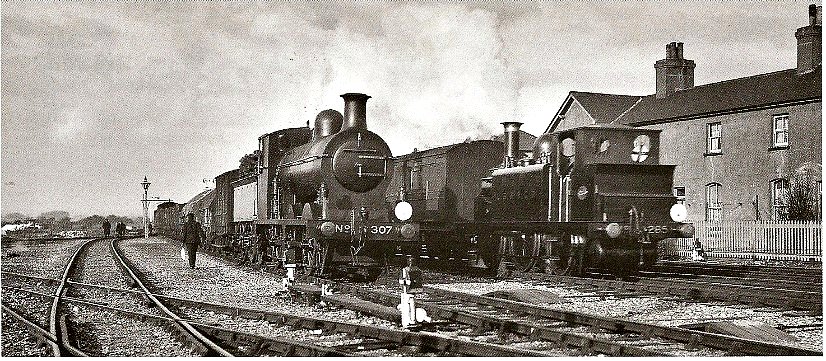
PHOTOGRAPHER UNKNOWN
LOCOMOTIVE WORKING ON
SUSSEX BRANCH LINES 1902
EXTRACTED AND ADAPTED THE JOHN PELHAM MAINLAND
FROM RAILWAY MAGAZINE FEBRUARY 1902
At the beginning of the century, the working of the locomotive depots at Littlehampton, Bognor, and Midhurst exhibit
many interesting features directly traceable to mid -Victorian practice. These depots were included in the Horsham
Locomotive District; Midhurst and Littlehampton had four engines each, and Bognor two engines. At least one engine
at each shed was designates the “Branch Engine,” a relic of the practice established by John Chester Craven,
Locomotive Superintendent of the L.B.S.C.R. from 1852 to 1869.
The Locomotive Foreman at Horsham made a tour of his District on the last Wednesday of each month. Leaving
Horsham at 10.20 a.m. the circuit of inspection occupied no less than 7 1/2 hours, unless as sometimes happened,
Bognor was omitted on a verbal assurance being given by the fitter in charge at Littlehampton that “they were all
right there”; this reduced the time by 2 1/2 hours.
The choice of the day was a relic of the past; it had been originated with an old instruction which held the foreman
personally responsible for certifying that the reserve coal stack had not vanished in whole or in part, and that the oil
stock was according to the books, and had not been diverted to other purposes. Occasionally, on the second
Wednesday of the month, the foreman paid a visit to Littlehampton only, but this was an exceptional measure of
supervision. The reason for the choice of Wednesday was that on this day the Outdoor Locomotive Superintendent
regularly visited the Chief Offices at London Bridge and therefore was not likely to descend upon Horsham, and find
the Foreman absent.
For all practical purposes the telephone was non-existent, the only means of communication, other than by rail-borne
letter, being the single needle telegraph, known as the “speaking instrument.”
The immediate responsibility for these out-depots therefore rested upon the man in charge of the shed, and sol on as
he was conscientious in the discharge of his in charge of the shed, and so long as he was conscientious in the
discharge of his duties, everything worked satisfactorily. The standard of locomotive maintenance at these depots
compared favourably with any other shed on the system, the mileage run between shop repairs averaging 65,000 in a
period of about 2 3/4 years. The general arrangements were primitive by modern standards, but were suited to the
conditions of railway working at that time.
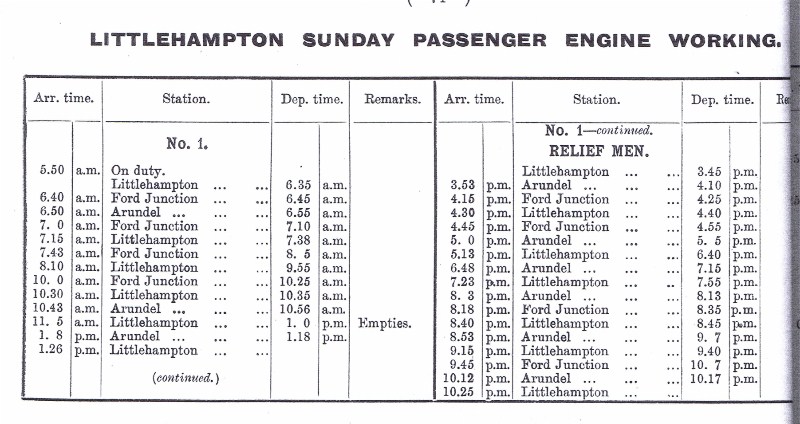
Variations of the standard engine workings, as diagrammed, were confined to local adjustment at the time of the
annual revisions of the timetables, and at holiday times, when late running of the London - Portsmouth trains resulted
in unscheduled trips on the Bognor and Littlehampton branches. During the Goodwood Race period (the week before
the August Bank Holiday) some slight adjustments were made to the train service on the Midhurst branch.
All clerical and administrative work was done at Horsham, as were repairs which could not be carried out by the
fitter stationed at Littlehampton. The sole boilermaker visited the out depots if necessary, but such occasions were
exceptional, engines being worked up to Horsham on suitable duties and charged over as required. Additional
personnel, other than repairs staff, were provided from Horsham to cover sickness, leave, and other similar
contingencies, as well as for special traffic requirements. Engine power for the latter was usually supplied from
Horsham as well. In practice, if any member of the staff fell sick, provisional arrangements to cover his duties had to
be made by the local man in charge of the depot until a substitute could be produced from Horsham, which ordinary
was not until the following day. That life on the railway was much less strenuous for the fact that Horsham was not
frequently troubled by such applications.
When a vacancy at any of the four depots occurred, it was filled by the senior man in the junior grade in the district,
unless he expressed his desire not to do so, in which case the offer went to the next senior and so on. In the event of
the post of fitter-in-charge at Littlehampton becoming vacant, the appointment was made but the Outdoor Locomotive
Superintendent, Brighton.
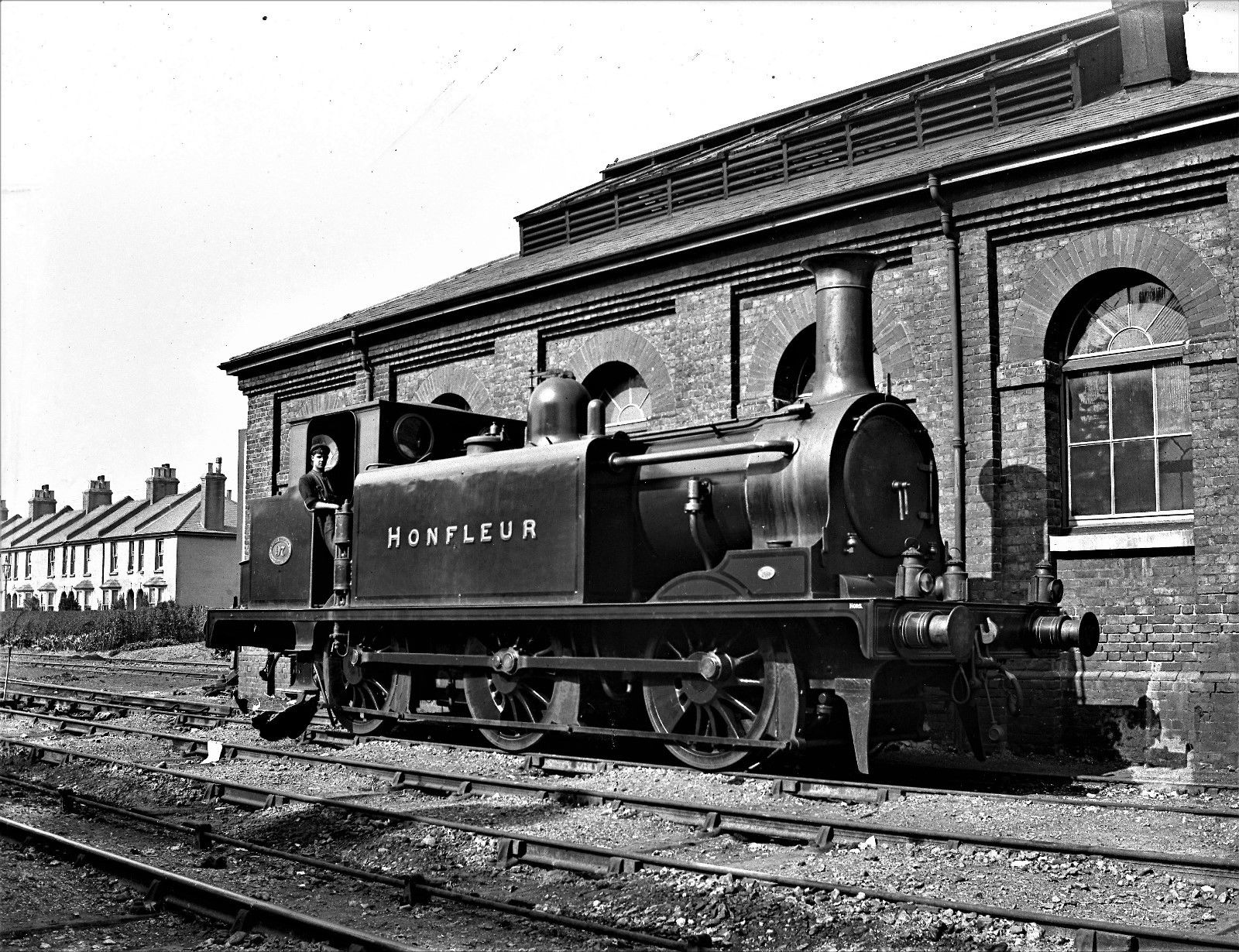
The shed at Littlehampton, in which four tank engines could just be accommodated, and locomotives enthusiasts could
obtain close up views of the engines from the public highway. There was consequently no occasion for any
contravention of the law of trespass, or fear of prosecution for loitering such as was the case at Bognor and
Midhurst. Nevertheless, warning notices exhibited on the Company’s premises against loitering and trespassing were
so numerous and conspicuous as to suggest to visitor that the local inhabitants possessed a particular flair for such
offences, but the present writer knows of no case in which it was necessary to summon assistance from the Police
Station immediately opposite the shed.
At Littlehampton, the fitter was in charge, and during the daytime he usually was to be found there, except on
Mondays and Wednesdays, when he visited Bognor and Midhurst respectively to carryout repairs to the engine
stationed there. Having but ten engines to look after (a small number for those days) the post was considered to be an
easy one, as it undoubtedly was if action was taken to forestall mechanical troubles.
As Littlehampton possessed direct rail access from the Brighton, London and Portsmouth directions, it never partook
of remote character associated with Bognor and Midhurst, and engines stationed there were more generally visible,
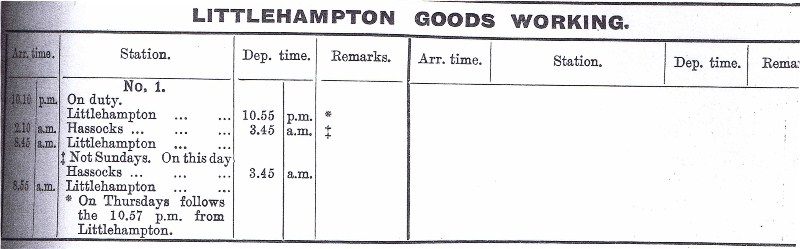
as they have a much less restricted range of operation. The Littlehampton goods engine worked from that station to
Brighton via the Preston Park spur on Monday to Friday nights inclusive, the enginemen being on duty 12 hours a
night, thus completing their 60 hour week in five night. It was washed out by the pump-man on Monday mornings. The
“ local service engine,” a Stroudley 0-4-2 tank in 1900, worked a turn daily as far as Three Bridges and back. This
engine, and the branch engine, were washed out regularly after six days’ worked by the pump-man (but not on a
Monday) the spare engine being used to cover their normal duties on such occasions.
* John Pelham Maitland, was a Loco Foreman at Newhaven & Littlehampton loco sheds.
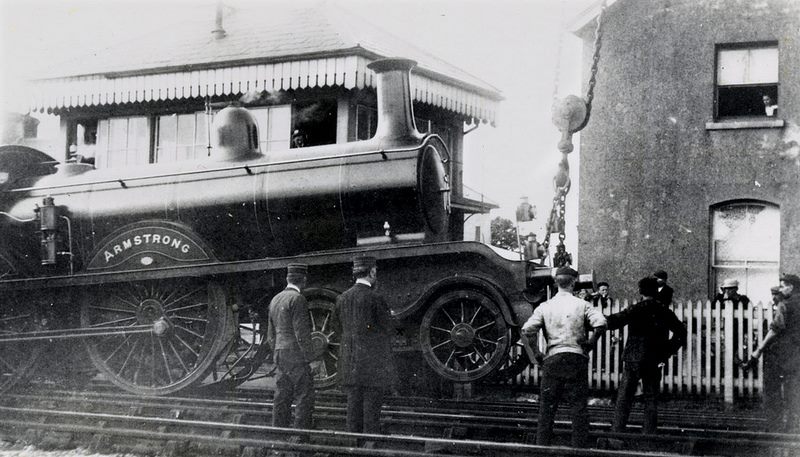
PHOTOGRAPHER UNKNOWN
Derailment at Littlehampton 1904
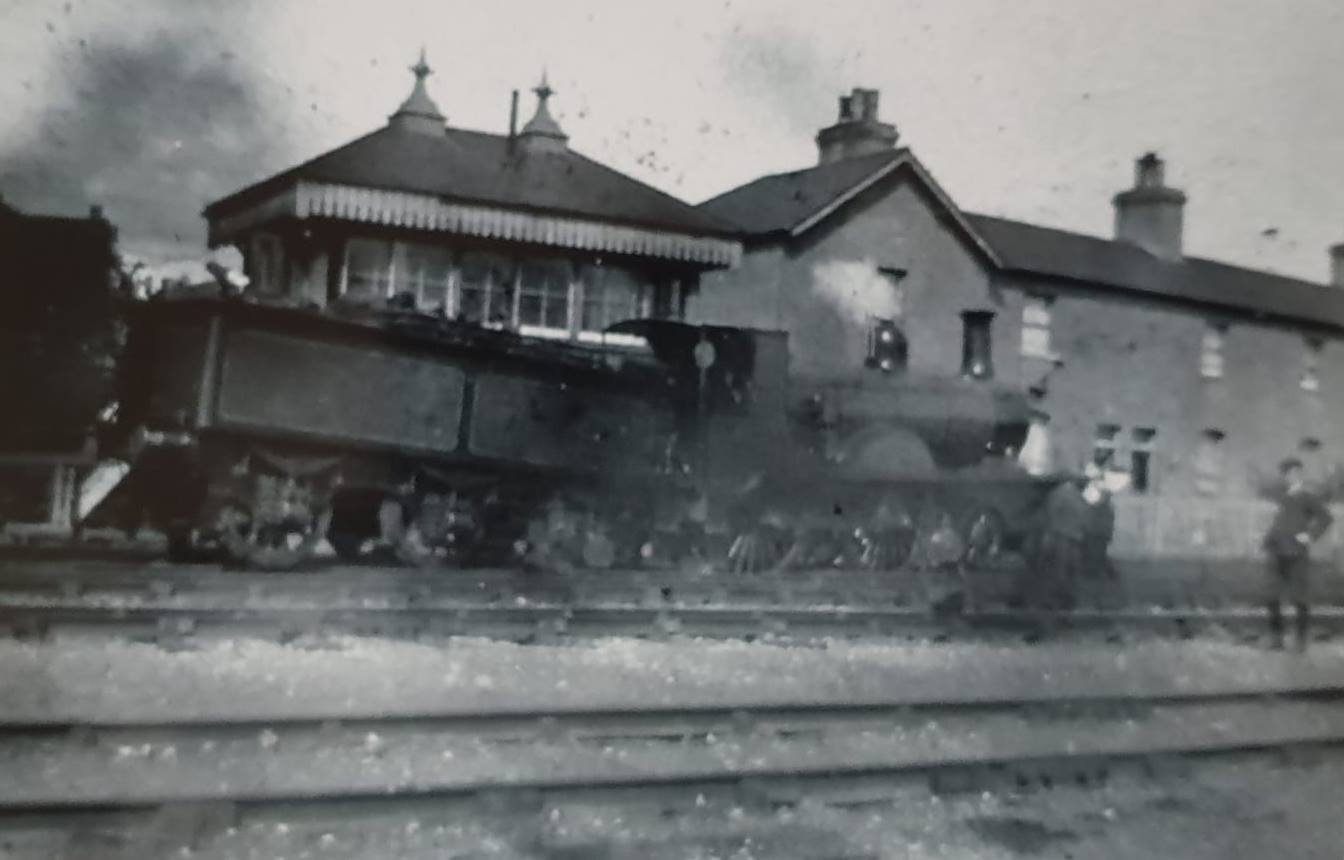
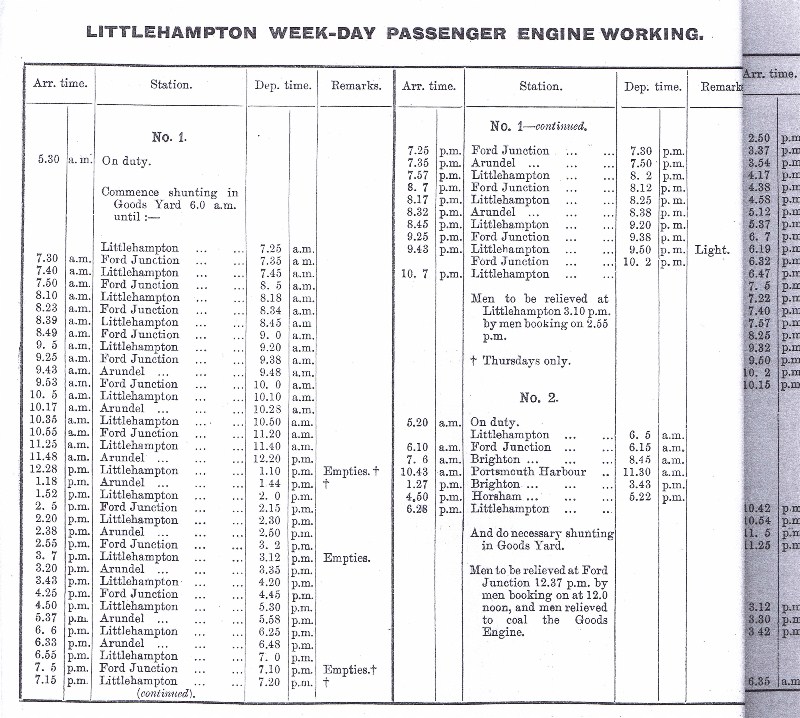
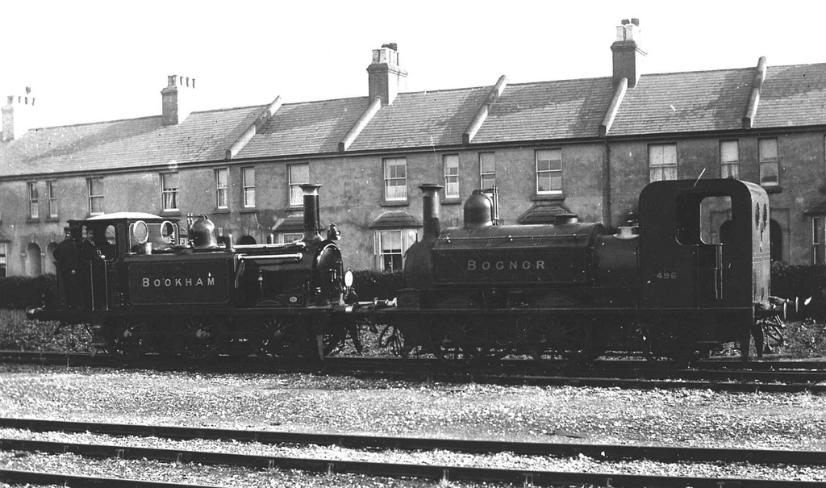
Above L.B.S.C.R Locomotive workings for October 1912
PHOTOGRAPHER UNKNOWN
LOCOMOTIVE JOURNAL
JULY 1913
Extracted from A.S.L.E.F. Organising Secretary
W. Warwick's report
page 316
My next move was to meet a subcommittee of London. Brighton and South Coast Railway delegates, and then to
Littlehampton for an open meeting on the Sunday (4th May). This is a small locomotive centre, but has sufficient to
support a branch, and I hope in the near future to be able to open one there. My experience is that all the small
centres on the various companies are coming into line and getting a branch of their own instead of being attached to
the branches at the larger centres. This is as it should be, because it puts every centre, no matter how small, in direct
communication with the General Office, and not only secures them information at first-hand, but so links the whole of
the locomotive-men up that all can be in touch with General Office and each other at the shortest possible notice, and
so does away with the weak links in the chain which should bind all together. There is no doubt a good deal of truth
in.that saying, viz. : that any chain is only as strong as its weakest link. These small centres have been weak links, but
I hope in the near future these weak links, will be removed and new ones forged in their stead, in the shape of a
branch of our organization, wherever there is the requisite number of men to carry on the same. I am pleased to say
this is nearly an accomplished fact in my district, as I have had the pleasure of opening no less than six such branches
this year.
PHOTOGRAPHER UNKNOWN
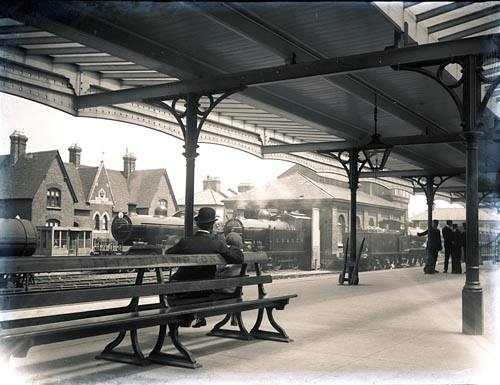
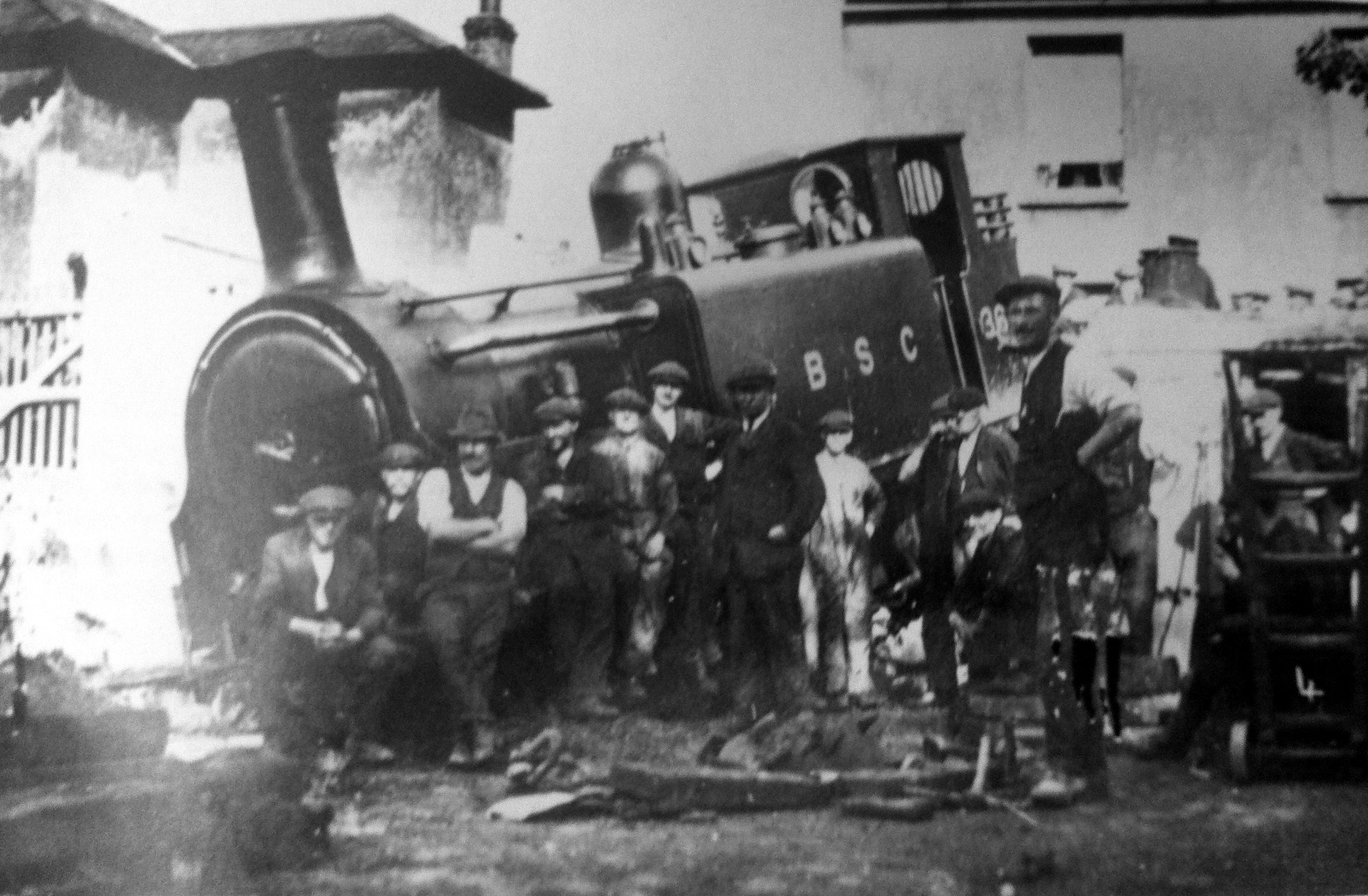
LITTLEHAMPTON STATION ON THE 4th AUGUST 1920
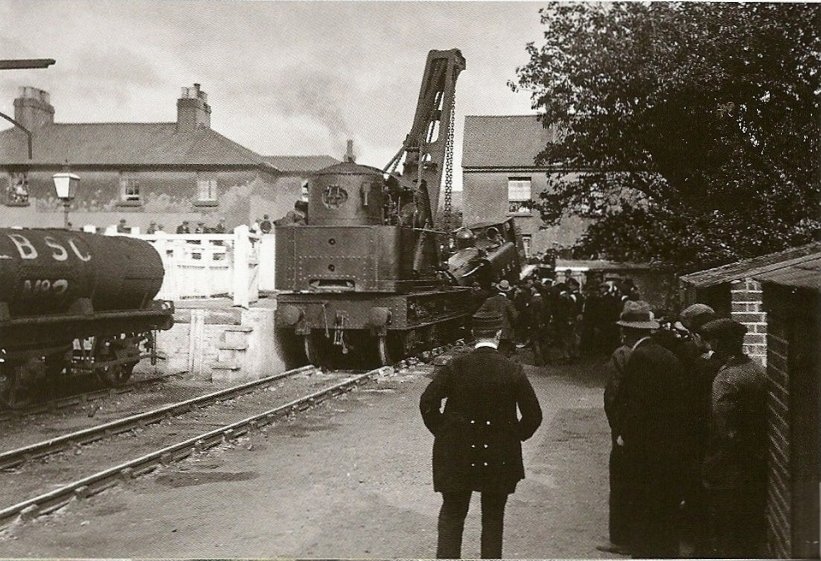
On the 4th August, 1920, Driver Edwards, and his Fireman Chapman, was in charge of engine No. 360. Whilst
running bunker first into Littlehampton station with the 1.10 p.m. from Ford Junction. The brakes failed to act and at
about 30 M.P.H. the engine demolished the buffers, crashed through the boundary wall behind and came to rest in the
street.
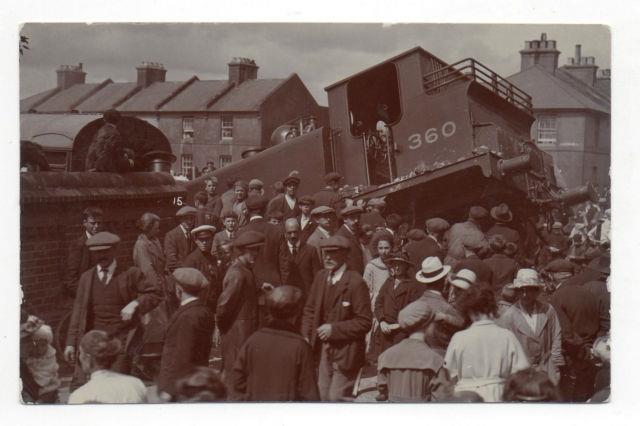
Of the thirty passengers on the train,
thirteen received injuries. All this was the
result of the wrong hoses being
connected between the engine, which was
not motor-fitted, and the first coach of the
train which was one of the specially
equipped trailer cars and had a section
of hoses to choose from. The wrong pair
were chosen and not discovered by the
guard.
Driver Edwards and fireman Chapman
Click on icon for the full report
POSTCARD
PHOTOGRAPHER UNKNOWN
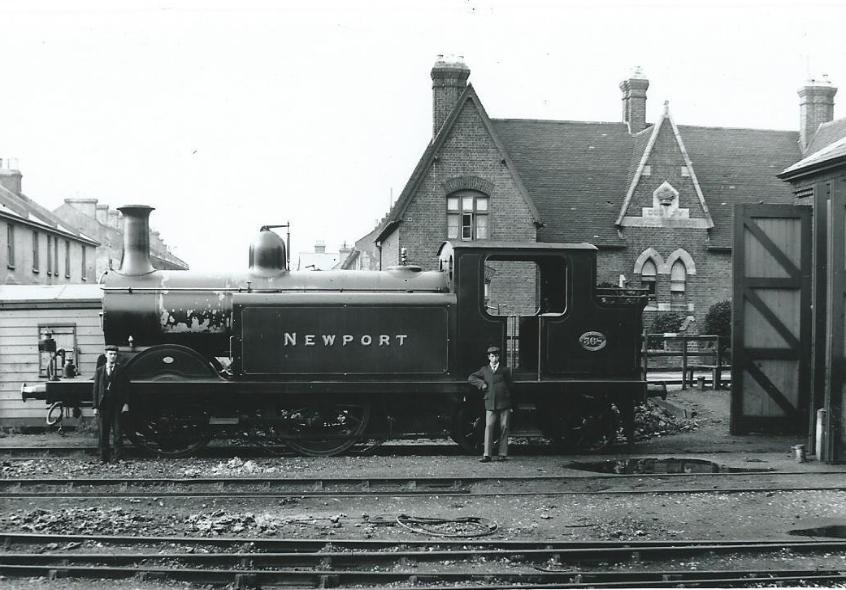
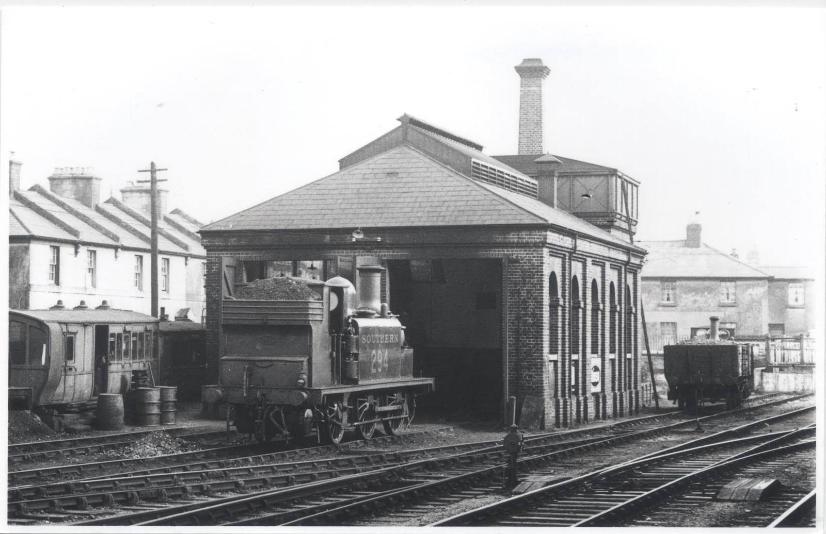
LITTLEHAMPTON LOCO SHED SCENES
PHOTOGRAPHER UNKNOWN
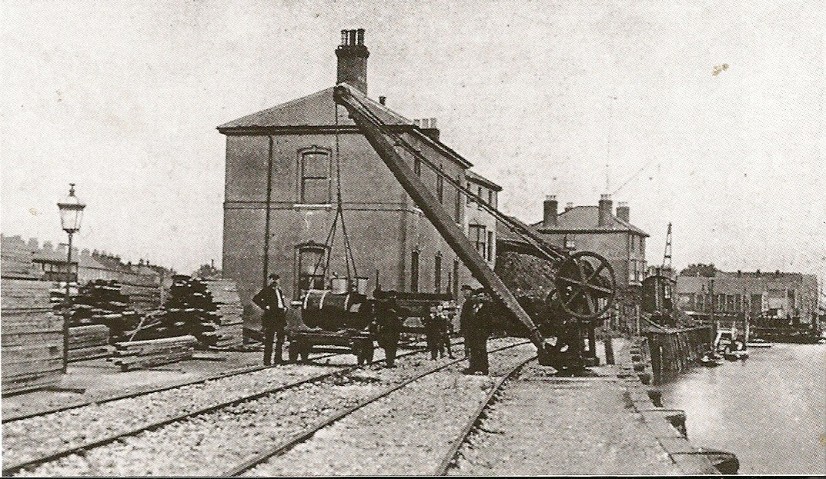
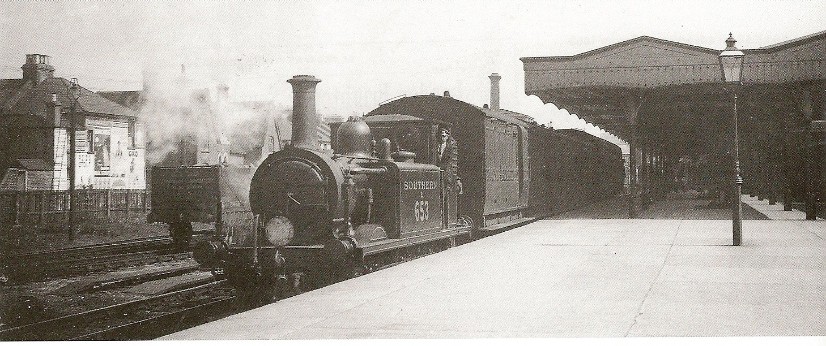
Littlehampton Wharf c1910
LOCOMOTIVE JOURNAL
MAY 1929
BOGNOR AND LITTLEHAMPTON BRANCH
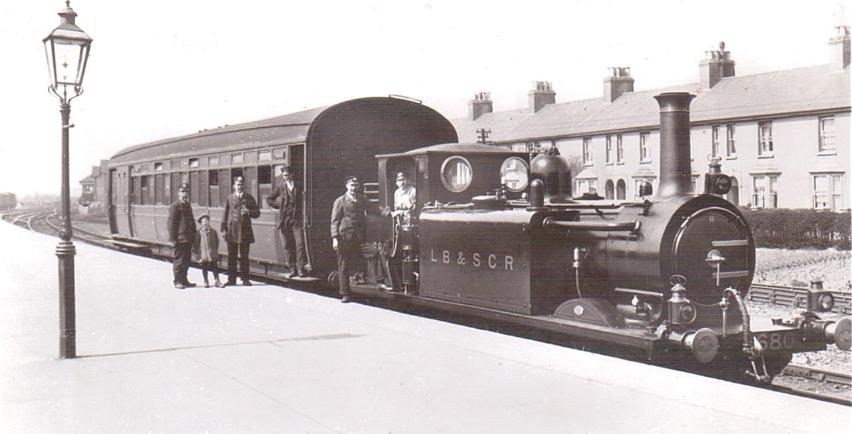
I would draw the attention of the “Bognor” members that our meeting night is Wednesday, at 7 p.m., every third week,
at the Terminus Hotel. During the years 1927-8 the uncomfortable branch-room was the reason given for small
attendances, but, I am prepared to wager that a room to surpass the above mentioned for comfort and homeliness
cannot be found. Having, therefore, surmounted the difficulty of an uncomfortable room, I am at a loss to understand
the reason for small attendances. During my annual holiday, I devoted three days to branch business by holding two
special open meetings and attending to L.D.C. matters. The attendances were very poor. If I were neglectful I should
expect such meetings, but I defy anybody to bring that charge. Complaints, grievances, and suggestions, have all
gone through their proper channels, almost as soon as receiving them. I’ve pretty well worn the carpet out in the
“Loco.” Office, trotting in and out. Therefore, I repeat: “why such meagre attendances?” Now, “Wake up,” Bognor,
and let’s hear your voices raised in the branch-room a little more often, instead of in the “lobby,” for surely two hours
devoted to branch matters is not a great sacrifice out of six weeks. A word of congratulation to the Littlehampton
members on the splendid attendance at the last two monthly meetings.
W. LAWRENCE, Branch Sec.
ELIZABETH WICKSTEAD COLLECTION
LOCOMOTIVE JOURNAL
MAY 1930
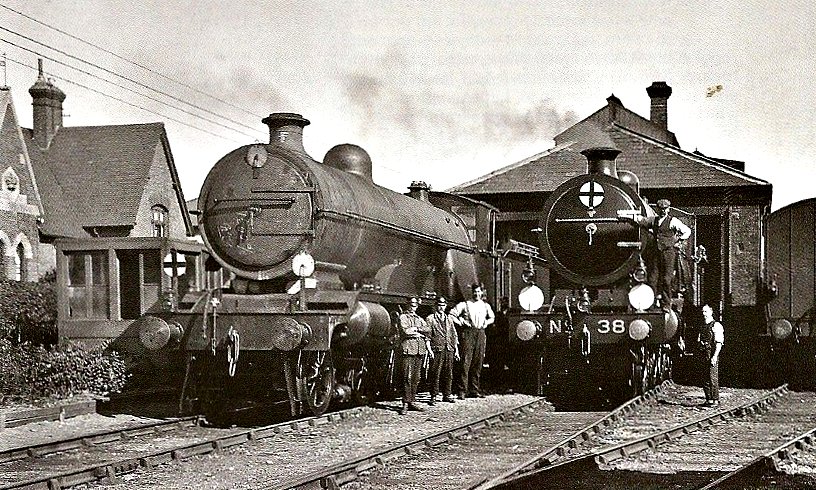
BOGNOR AND LITTLEHAMPTON BRANCH
I feel I must take an opportunity of expressing my thanks and appreciation to the members of the above for their
assistance and help during the year 1929, and for apparent confidence felt, by again electing me as you secretary and
shed committee representative, with Bro. H. Roger. I think we can look back upon the last 12 months with a fair
amount of satisfaction, both from a membership point and an amicably working depot. Bro. Rogers will bear me out
when I say that some of our committee meetings, during 1929, were rather trying ordeals, from the point of view of
gaining a point (which was very rare) I must admit, and in some cases fighting to hold what we were just entitled to.
When the foreman (that was then) greeted me with the remark, “Well, Lawrence, what is it this time, as much as I like
you, I begin to hate the sight of you,” I think you’ll agree that it wasn’t exactly encouraging, but I will also admit that
I was rather flattered, for o think I must have been a sort of a nightmare to him, I honestly believe he meant it, too.
Anyway, I think we parted fairly friendly when he left us, so all’s well that ends rough. Well, now that we have entered
upon another year with a new foreman and naturally new ideas, which, providentially for us, have proved beneficial
to all, it’s up to us to look after them. Although I know there is no emphasize that point, I would like to lay stress upon
the importance attaching to the branch meetings. For that is the place for the discussing of your workings, that your
committee may go into conference with the knowledge that everybody approves of what is going to be done. Always
remember, that to look after your interests and maintain efficiency, you must be conversant with present happenings,
and to do that just spare that 2 hours one evening a month, and see and hear what’s doing. The attendances, of late,
have been fairly satisfactory, but there is still room for improvement, so we commence our meetings again I would like those to this applies to bear it in mind.
Another point well worth mentioning applies to the “Arrears Link.” It is rather deplorable habit, makes more work
for me and a bit more for Head Office and will, one of these days, cause yourselves perhaps years of regret. You will
find occasion when assistance and representation would be a wonderful asset, but owing to your being “out of
benefit” you couldn’t get it, and don’t come to me with any expectation of sympathy, because you won’t get it, and I’ll
tell you why. If two and more share are preferred in the sweepstake, then let the sweepstake look after your future. I
wouldn’t mind so much if you parted up with a portion of it when you won, but you don’t, or won’t. I’m not by any
means condemning football sweeps, for I’ve got one share myself, but as soon as it interferes with my contributions,
then I’m quitting, before the sweepstake condemns me. Get that, do you? Just you think about it, and the explanation
won’t be hard to find.
Well, I won’t utilise anymore of our journal’s valuable space, and if all this is published I only hope and trust that
some good comes of it. I’ll write again when my contribution return book shows “no arrears.”
W. LAWRENCE,
Branch L.D.C. Secretary.
PHOTOGRAPHER UNKNOWN
PHOTOGRAPHER UNKNOWN
LOCOMOTIVE JOURNAL
FEBRUARY 1931
BOGNOR AND LITTLEHAMPTON BRANCH
A few words from us I am sure will not come amiss. Firstly, a glance back over 1930, I believe gives us a satisfactory
reflection. Certainly one or two matters that were unforeseen I have no doubt will be remedied before overtaking us in
the New Year. Here I must mention that it Is a great asset to have a foreman who is always ready to listen to
reasonable suggestions for betterment of our working conditions, and furthermore will also assist in alleviating any
difficulties, sometimes, as I am aware, at a good deal of personal inconvenience; also, to have satisfaction expressed
for our carrying out allotted duties was, to say the least, surprising, but nevertheless greatly appreciated. We can do
no better than make 1931 even more successful, that is providing the companies leave well alone.
To enter into 1931, I must first of all express my appreciation of the apparent confidence shown in me again by
electing me as your secretary, and I take this opportunity of thanking one and all, and trust there will be no cause for
you to regret your choice. It is also well worth mentioning, that with the exception of one most desiring re-election, all
other 1930 officers were returned unanimously. That in itself, I think, expresses a great deal. I would also
congratulate the members upon the way contributions were paid and several cases of arrears wiped off. These in
some cases, be it noted, before the Companies’ proposal were known. Judging from the present situation, I don’t think
the arrears for December will be much to talk about. Whilst broaching the subject of the companies’ suggestions that
are staring us in the face, I am relying upon this branch to respond to the “Stand to Arms” call, should it be necessary
to sound same. We, of course, are aware that our two slugs are awaiting the opportunity to still further deprive us of a
decent standard of living. It is pleasing to note that our E.C. have taken the time is not far distant when wedge will be
driven completely home. It is beyond understanding why men who call themselves “Trade Unionists” can find time to
associate with such scum. Furthermore, to listen to them and be influenced by what they say gets me groggy. Dirty,
low-down, sneak thieves, and yet some of you are afraid to treat them in the manner they should be treated-sooner go
and treat them to half-a-pint of beer. So would I? Still, it doesn’t seem to have much effect. I’ve talked till I’m very
nearly sick with talking, so I only hope the day isn’t very far distant when others methods will deal with them. In
conclusion, I would again remind certain members that our branch meetings are still held at the Terminus Hotel,
Bognor Regis and the Labour Hall Littlehampton. With fond hoped that the New Year will be much brighter than
present outlook affirms.
BRANCH SECRETARY
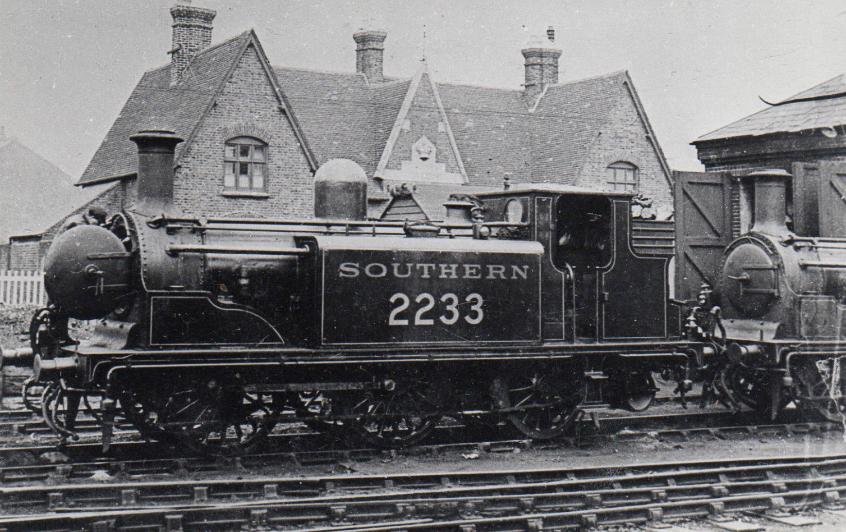
PHOTOGRAPHER UNKNOWN
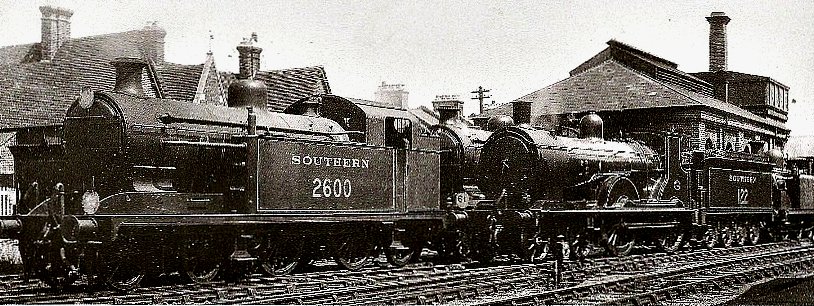
PHOTOGRAPHER UNKNOWN
THE SUSSEX MOTIVE POWER DEPOTS WEBSITE.
HAS NOW BEEN MOVED TO A NEW SITE CALLED
IGNITING THE FLAMING OF UNITY
PLEASE CLICK ON THE IMAGE BELOW
TO TRANSFER TO THIS NEW SITE
CLICK ON THE ABOVE IMAGE TO TAKE YOU
TO THE NEW UPDATED COMBINED AND WEBSITE
IGNITING THE FLAME OF UNITY WEBSITE
https://ignitingtheflameofunity.yolasite.com/
THIS WEBSITE COMBINES THE FOLLOWING WEBSITES
THE BRIGHTON A.S.L.E.&F., THE BRIGHTON MOTIVE POWER DEPOTS
& THE SUSSEX MOTIVE POWER WEBSITES
WHICH EXPLAINS THE EVOLUTION OF THE FOOTPLATE GRADES AND THE
HISTORY OF THEIR TRADE UNIONS AND THE STRUGGLES TO IMPROVE
THEIR WORKING LIVES